 Devloop
Mo's Experiences
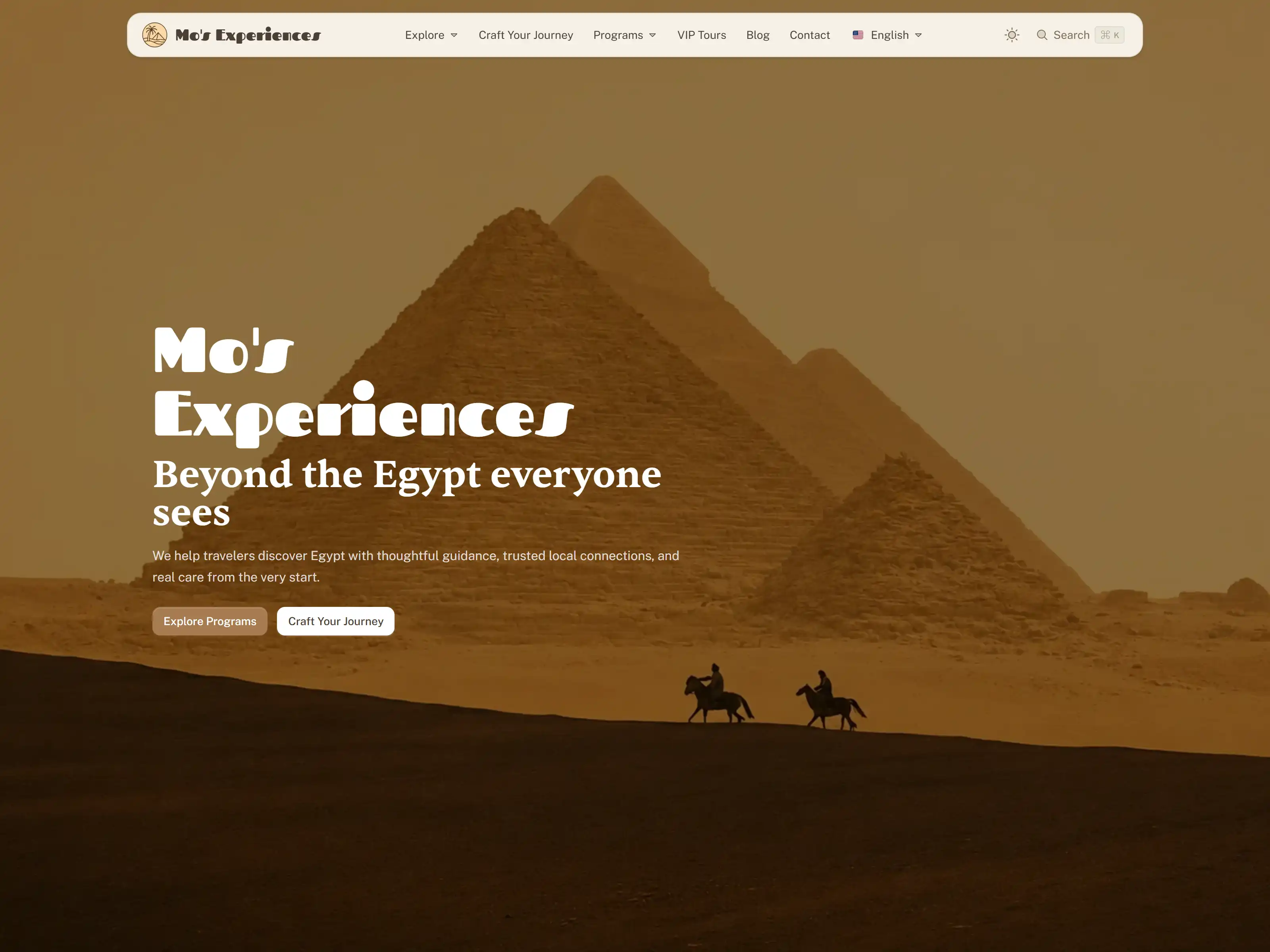
A bilingual Egypt travel platform that gives travelers a clear route to inquiry and gives the team direct control of the content behind it.
- Client
- Mo's Experiences
- Timeline
- October 2025 to July 2026
- Type
- Website
At a glance
- Client: Mo's Experiences
- Sector: Travel and tourism
- Delivery: October 2025 to July 2026
- Audience: English- and French-speaking travelers planning a trip to Egypt
- Scope: Public website, editorial dashboard, bilingual content system, SEO, email, and analytics
The brief
Mo's Experiences needed a useful Egypt travel site without making its team dependent on developers for routine content work. Travelers needed to understand destinations and programs, compare what fits their trip, and ask about a journey shaped around them. The team needed direct control of programs, destinations, articles, images, search metadata, and publishing in English and French.
Those needs had to work as one product. A public site that could not stay current would soon lose value. A flexible content system that produced uneven pages or unclear choices would fail travelers instead.
The system
We built the public website and editorial dashboard around one structured source of truth. The dashboard owns the names, summaries, itineraries, FAQs, images, metadata, and publishing state that travelers see. The application owns the layout, interactions, and visual rules. Editors can update what a page says without rebuilding how it works.
English and French are part of the data model and route structure. Each language can be published independently, while one shared policy keeps publication and indexability aligned across the public page, metadata, sitemap, and robots rules.
Services
- Product and content architecture
- Information architecture and bilingual route design
- Public website UX and interface development
- Editorial dashboard and content-model design
- Technical SEO and structured data
- Transactional email and first-party analytics
- Accessibility, performance, and quality checks
What travelers and the team can do
- Travelers can browse localized destinations, categories, programs, VIP tours, articles, galleries, contact, and custom-trip pages, then move from discovery to inquiry through clear next steps. Responsive program pages bring together structured itineraries, practical details, FAQs, and related content. Inquiry and review forms send transactional email.
- The team works in a page-aware dashboard for programs, destinations, categories, articles, testimonials, media, settings, and team access. Structured fields follow the public pages instead of exposing a blank-page canvas.
- Rich-text editing is available where it helps, with fixed content rules where consistency matters. Editors manage metadata, social images, routes, redirects, publication, and ordering. Role-based access is enforced through database policies.
Search visibility is part of the architecture
The public rendering and content systems follow one SEO contract. Meaningful headings, copy, and links arrive in the first HTML response and remain available without JavaScript. Loading states cannot replace the server-rendered page or hide its main content. Invalid and unpublished entities return real 404 responses. Canonical URLs, language alternatives, sitemaps, robots rules, and page-level index controls use the same publication policy. Auth pages use page-level noindex; program pages use one responsive content tree instead of duplicate mobile and desktop markup.
The system verifies all 166 URLs in the current sitemap against the sitewide HTML limit, then examines representative route families through raw responses, rendered content, and Googlebot responses. Automated checks also cover rendering, navigation, status codes, index controls, layout stability, and HTML payload size.
Outcome
Mo's Experiences now has one system for the public site and the work that keeps it accurate. Travelers have a focused path from research to inquiry in either supported language. Editors and SEO specialists can update the content and search signals tied to those pages without calling on a developer for routine changes. New programs follow the same rendering, payload, and indexability rules as existing ones, so the catalog can grow without page-specific fixes.
Delivery
- October 2025 to May 2026: data model, access rules, and editorial dashboard
- June 2026: public website, bilingual content, email, performance, and SEO work
- July 2026: analytics, SEO rendering architecture, payload controls, and quality checks
Technology
Next.js, React, TypeScript, and Tailwind CSS power the application. Tiptap, React Hook Form, and Zod support content and forms. Supabase provides PostgreSQL, authentication, and row-level security. next-intl handles language and routing, while Resend, React Email, and Umami cover email and first-party analytics.
Project record
The project DNA records the product and brand rules. The SEO rendering contract and quality checklist record the indexability safeguards that apply as the site grows.